How our ability to navigate the world is connected to self-development
An introduction to Robert Kegan's Three Stages of Adult Development and how it impacts individuals ability to navigate a complex world


A year ago, I was in Helsinki for the second module of Hanaholmens Tandem Leadership program, which brings together young leaders from Sweden and Finland.
Apart from ending up very sick with whooping cough on my way home, I enjoyed both the lectures and the socialising — Finland is famous for both sauna and karaoke.
Out of all the content we consumed, one graph from a lecture by the Finnish foresight agency SITRA has stuck with me ever since.
It examines the categories of individuals' ability to meta-think and cope with complexity, and tells us a bit about who excels at this skill.
I refer to Robert Kegan's research in my daily life at least once a month. Often, as a comment on why our world might look like it does, with disinformation, polarisation and online hate. But it goes way beyond that. It’s a theory of adult development and how we transform through life.
Most readers of this newsletter share my interest in self-development. This research provides valuable insights into how we can further develop.
The good news is that we can develop throughout our lives.
Let’s take a look:
Robert Kegan was a psychologist at Harvard known for “constructive-developmental theory”. This view looks at development in adults not just as a process of acquiring knowledge, but as a transformation.
As we develop, we are changing our “meaning-making systems,” the system that enables us to make sense of who we are, what happens to us, and how we relate to others and the world.
For example, if you reread a book that you read as a young adult, you see it very differently. This difference is because you have transformed as an individual between the two readings.
What has fascinated me about this theory is that it is not “age-based”. There are no longer any predicted growth sprints or mental phases. As we become adults, not everyone develops.
Most adults remain in Stage 3, and there is no automatic or guaranteed progression beyond that stage. Progression through these five stages often requires deliberate transformation—a compelling argument for inner development work.
But the capacity to develop beyond that is something we all inhabit; we just need the will or opportunity to explore it.
From Subject to Object
One of the core ideas in Kegan's Theory of Adult Development is the "subject-to-object shift". It describes how individuals grow psychologically by gradually learning to step back from things that once defined us and instead take a perspective on them.
As we develop, we move from being controlled by something (subject) → to being able to see it, reflect on it, and work with it (object).
Anyone who has ever been to therapy knows that this process is a helpful way to begin understanding oneself and one's patterns.
Five stages through life
Kegan’s theory describes five different stages. The first, Impulsive Mind, occurs in early childhood (ages 2-5), and the second, Imperial Mind, happens in adolescence. While some adults never progress beyond these two stages, they are not considered part of the adult development process.
We will go through steps 2-5. With a focus on the three latest stages, The Socialised Mind, The Self-Authoring Mind, and the Self-Transforming Mind.
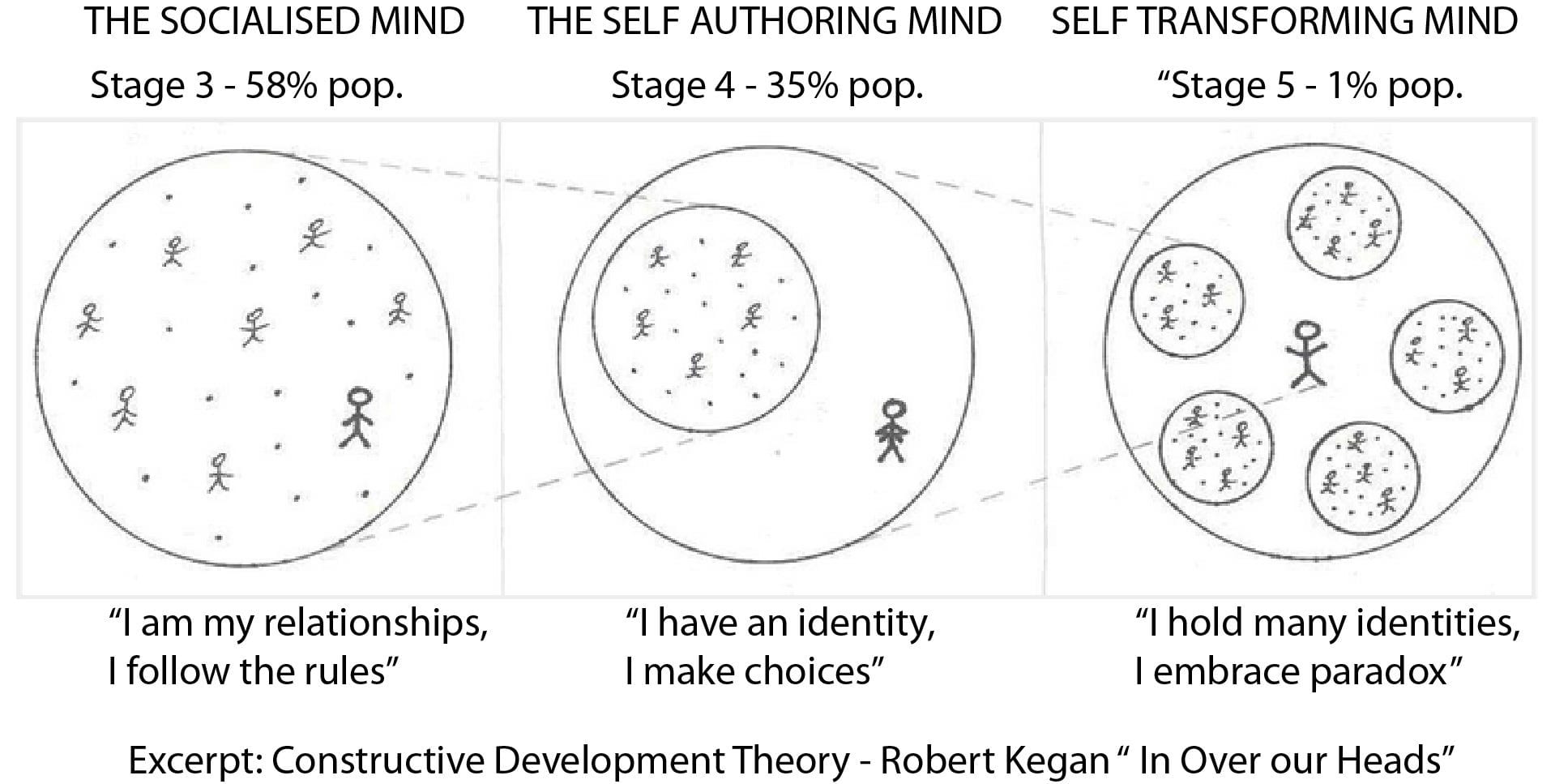
Robert Kegan's Constructive Development Theory
Stage 2: The Imperial Mind
Stage 2 typically applies to adolescents, as well as a small portion of adults — roughly 6%.
Here, individuals are primarily driven by their needs, interests, and desires. They are subject to these internal motivations, meaning they are embedded in them and cannot take a perspective on them.
However, they are “objects” in relation to their impulses, feelings and perceptions, as they can reflect on them and their impact. This allows them to have basic self-control and planning, but they are not yet aware, on any deeper level, of other people’s inner lives.
People at this level tend to form transactional, egocentric relationships: other people are mainly viewed as resources to help you fulfil your personal goals.
Stage 3: The Socialised Mind
Stage 3 is where the majority of adults — approximately 58%.
Here, a person’s sense of self is shaped by relationships, social expectations, and external influences such as family, culture, religion, or community. People are subject to these relationships and mutual experiences, and cannot yet step back to evaluate them independently.
However, they have now become “objects” in relation to their personal needs and interests, and are no longer under their control. This allows them to suppress their own desires to prioritise group harmony or social norms.
At this stage, people often seek approval and validation from others. Their beliefs and values are typically adopted from those around them, rather than being self-generated. They usually struggle to know what they want apart from what others expect of them, and conflict is challenging because it threatens the relational structure they depend on.
Stage 4: The Self-Authoring Mind
Approximately 20–35% of adults progress to stage 4, depending on the study. In this stage, individuals develop a strong, independent sense of self. The expectations of others no longer define them; instead, they become the author of their own identity, values, and ideology.
These self-authored structures are now the subject, while their relationships and external influences have become objects, allowing them to reflect on and manage them.
Individuals in Stage 4 can question social norms, set personal goals, and make decisions based on internal principles. They take responsibility for their emotions, values, and perspectives. They can also recognise the limitations of their identity and values, and begin to understand that they themselves are works in progress.
This stage enables independent leadership, fosters deep reflection, and promotes clarity of purpose. But their self-authored structures, their own identity, values, and ideology, can still be rigid.
Stage 5: The Self-Transforming Mind
Reaching Stage 5 is rare — research suggests that only about 1% of adults ever experience this level.
Here, even one’s self-authored identity and internal value system are no longer fixed. Rather than being subject to a particular identity or ideology, the individual views these things as objects — tools they can use, question, refine, or even discard.
This transformation allows for deep adaptability and openness to complexity. The self is no longer defined by any single narrative or belief system, but is seen as an evolving, dynamic process.
People at this level can hold multiple perspectives simultaneously, embrace contradictions, and live with ambiguity. They recognise that every point of view, including their own, is partial and limited.
Here, individuals can both lead and follow, challenge others and themselves, and remain grounded while questioning what once felt foundational. Their sense of identity is relational, co-constructed, and continually evolving.
Some methodological heads up
All the population estimates quoted here are based on Kegan’s own early writings (and widely repeated). However, they have not been identified by any rigorous epidemiological studies.
Like with all psychological models, especially those that are still relatively young, there are always critics.
My favourite critique is that some people argue that Kegan’s later stages can appear elitist, suggesting that higher complexity is “better.” However, Kegan only claims that later stages are more complex, not superior in any way.
Additionally, the model's practicality is questioned, as it is costly and time-consuming to determine which category each individual belongs to. This also leads to a situation where few extensive, long-term studies confirm the model. So far, most of the model's validation has been conducted by Kegan or affiliated research groups, which raises concerns about generalisability and objectivity.
How your stage impacts your ability to deal with the world
According to Kegan, the more an individual progresses through the stages, the better they will be at handling complexity.
Someone at the fifth stage, the Self-transforming mind, has better abilities in dealing with contradictions and can hold multiple perspectives better than someone at stage three, the Socialised mind.
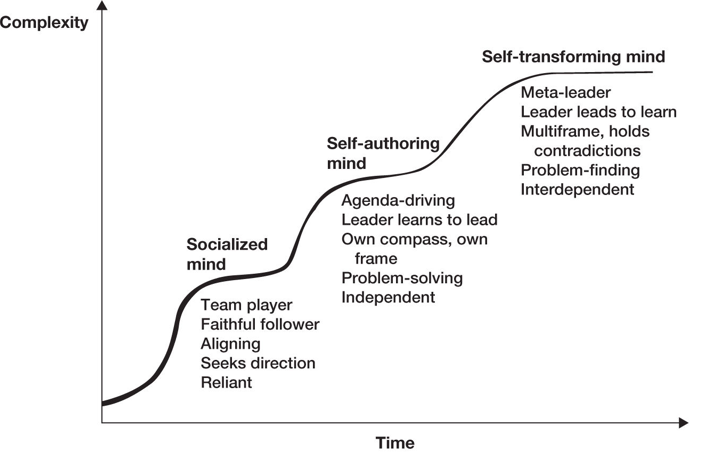
It is important to remember that it is not “better” to be at Stage 5 than Stage 3. I think we can all think of situations where individuals in Step 3 might have an easier time than those in Step 5 — and vice versa.
However, when we examine the types of societies we have today and what is required of individuals to make sense of everything that is happening in the world, having only 1% of people at Stage 5 might complicate things.
Some personal reflections
I think the beauty of Kegan’s model is that we can progress at any time in our lives. While getting older may correlate with becoming wiser, that is not always the case.
However, we can all develop, regardless of our current life stage. Sometimes the transformation starts with an external event, such as a breakup or illness; other times, it might be more internal—a wish to improve and optimise the current version of ourselves.
As someone interested in both my own personal development and human systems, such as organisations and society, this model provides me with an understanding of why we don’t all view the world in the same way.
It also gives me an understanding of what I could develop further personally, and how I might relate to people around me. I’ve begun to accept that not everyone is interested in self-development; that’s fine. But personally, I prefer to spend my time with those who are.
Also, I think it’s very easy when you get a model like this, just to assume you’re one of the people at Stage 5 — the 1%.
However, if you instead place yourself in Stage 3 or 4, you gain a valuable guide to the skills you should further develop. Because, no matter how far we progress, there are always areas for improvement—and this realisation in itself is part of reaching the later stages.